
Written and medically reviewed by Dr. Neha Banga, BHMS, MD (Homoeopathy) · Last reviewed 22 November 2026
The short answer: sneezing that starts the moment you wake up, with a runny or itchy nose and watery eyes, is often allergic rhinitis triggered by house dust mites. Winter in Hyderabad brings dry, dusty air and more time indoors with blankets and closed windows. Cutting down dust at home helps many people. See a doctor if symptoms keep returning.
Every November the same pattern appears in many homes around Nallagandla, Gachibowli and Tellapur. A child sneezes ten times before school. A parent reaches for tissues before the first cup of chai. By mid-morning, things settle – until the next day. Here is what may be going on, what you can check at home, and when to get help.
What is dust allergy, and why does it cause sneezing?
Dust allergy usually means an allergy to house dust mites. These are tiny creatures, too small to see, that live in mattresses, pillows, blankets, sofas, curtains and soft toys. Their droppings mix with household dust.
In some people, the immune system reacts to these particles as if they were harmful. The lining of the nose swells and produces mucus. This is called allergic rhinitis. It is not an infection, and it is not contagious.
Common signs include:
- bouts of sneezing, often several in a row
- a runny or blocked nose, with clear, watery mucus
- itchy nose, eyes, throat or roof of the mouth
- red, watery eyes
- pressure or fullness around the nose and forehead
Why is it worse in the morning and in winter?
Many people notice the worst sneezing in the first hour after waking. You have just spent seven or eight hours with your face close to a pillow and blanket – where dust mites are most common. Cool morning air can also irritate a nose that is already sensitive.
Winter in Hyderabad adds a few local reasons:
- Stored blankets and woollens come out of cupboards after months, carrying dust with them.
- Windows stay closed on cooler nights, so dust stays inside.
- Dry, dusty air and ongoing construction across the western suburbs mean more fine dust outdoors.
- Smoke from incense, mosquito coils, garbage burning and leftover firecracker smoke after Diwali can irritate the nose further.
- Early two-wheeler rides to school or to offices along the IT corridor expose you to cold air and road dust at once.
Is it a cold or an allergy?
The two can look alike at first. A few differences help:
| Usually a cold | Usually an allergy |
|---|---|
| Starts with a sore throat, body ache or mild temperature | No fever; sneezing and itching are the main signs |
| Mucus may turn thick or coloured after a few days | Mucus usually stays clear and watery |
| Settles within about 7–10 days | Comes back day after day, or season after season |
| Spreads to others at home | Not contagious; follows exposure to dust or other triggers |
If you are unsure, or a “cold” never seems to end, ask your doctor. Long-lasting symptoms deserve a proper check.
Which winter triggers should you check at home?
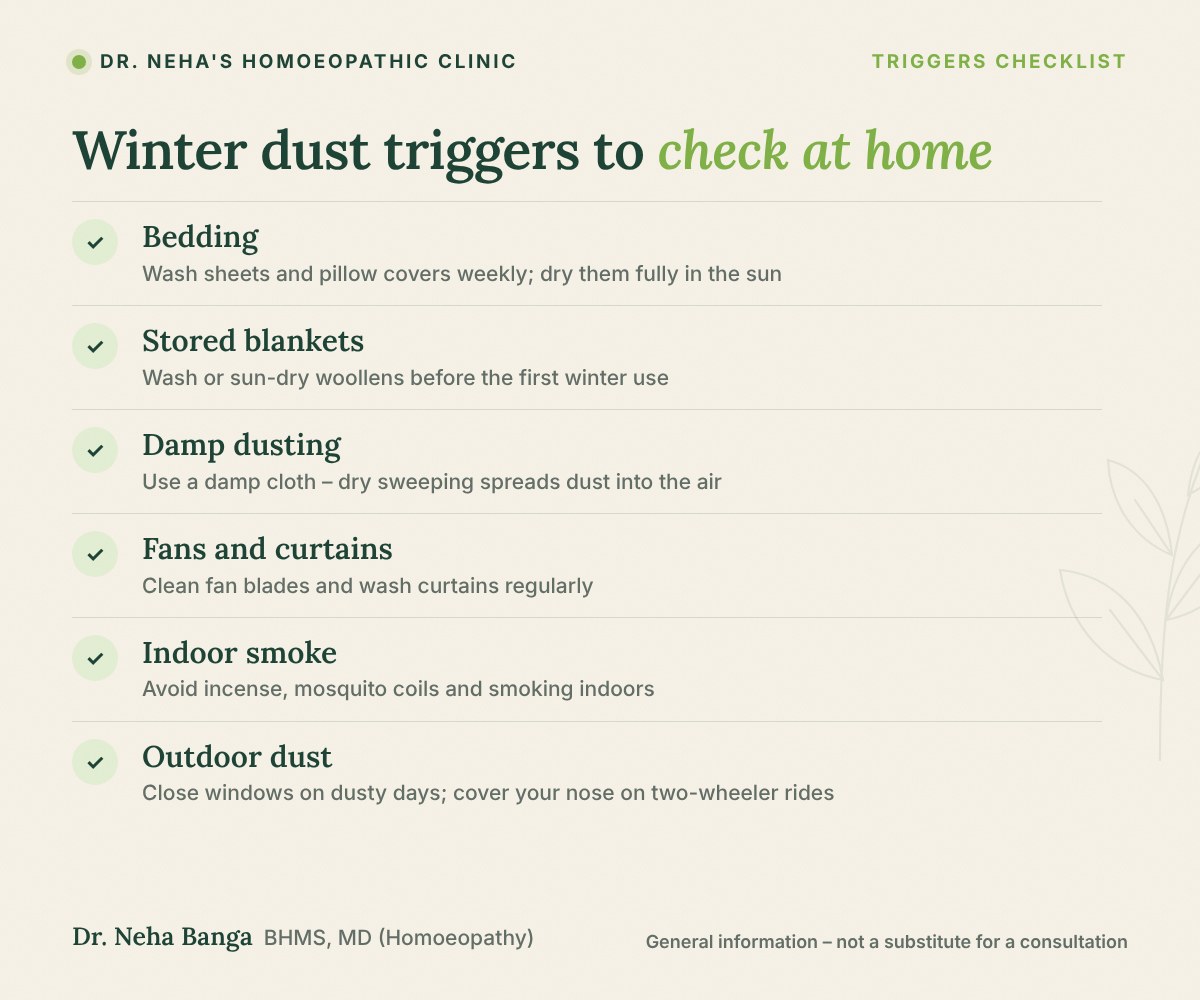
Walk through your home with this checklist. You do not need to do everything at once – start with the bedroom, where you spend the most hours.
- ☐ Bedding: wash sheets and pillow covers every week in hot water and dry them fully in the sun
- ☐ Stored blankets and woollens: wash or sun-dry them before the first use of the season
- ☐ Mattress and pillows: consider dust-mite-proof covers; replace very old pillows
- ☐ Dusting: use a damp cloth instead of dry sweeping or a feather duster, which spread dust into the air
- ☐ Ceiling fans, curtains and carpets: clean fan blades and wash curtains regularly; hard floors are easier to keep dust-free than rugs
- ☐ Soft toys: keep only a few on the bed and wash them often
- ☐ Smoke: avoid incense, coils and smoking indoors
- ☐ Outdoor dust: keep windows closed on very dusty or windy days, and cover your nose and mouth on two-wheeler rides
If someone at home already has asthma or eczema, these steps matter even more.
Does dust allergy affect children differently?
Children often show allergy in quieter ways. Look for constant sniffing, rubbing the nose upwards, breathing through the mouth, snoring, dark circles under the eyes, or tiredness at school after a poor night’s sleep. Allergic rhinitis and asthma often occur together, so a child with frequent cough or wheeze at night should be seen by a paediatrician.
When to see a doctor urgently
Go to the nearest emergency department or call 108 – do not wait for any appointment – if you or your child have:
- difficulty breathing, fast breathing or lips turning blue
- wheezing (a whistling sound when breathing) or chest tightness
- an inhaler that is not helping as much as it usually does
- swelling of the face, lips or throat, or a widespread rash
- a high fever that does not come down
- any breathing problem or fever in a baby, or a baby who is not taking milk well
Also see your doctor soon if a blocked nose is on one side only, if there are nosebleeds or thick coloured mucus, or if symptoms are disturbing sleep, school or work.
How can a homoeopathic consultation fit into your care?
At our clinic in Nallagandla, a first consultation is a detailed, individual conversation. We ask when the sneezing started, what time of day it is worst, what seems to set it off, your home and work routine, sleep, family history of allergy, asthma or eczema, and every medicine you already take. From that history, we agree a plan and a follow-up schedule – in clinic or by online video consultation.
If needed, we also plan alongside treatment depending on the case and patient history. Please continue your inhalers, antihistamines, nasal sprays and any other prescribed medicine – don’t stop any prescribed medicine without talking to your doctor. If you have asthma, keep following the plan your doctor has given you. Outcomes vary from person to person, and if we think you need tests or another doctor’s opinion, we will tell you plainly.
Read more about how we work in Asthma & Allergy: Homeopathy in Hyderabad, or book a consultation. You may also find these useful: Is homoeopathy safe? and Can I take homoeopathy along with my allopathic medicines?
Frequently asked questions
Why do I sneeze only in the morning?
Overnight, you breathe close to pillows and blankets, where dust mites are common. Cool morning air can add to it. If the sneezing settles by mid-morning and returns daily, allergy is a likely reason – but ask your doctor to confirm.
Can dust allergy start in adulthood?
Yes. Allergies can appear at any age, including after a move to a new home or city. A doctor can help work out what is going on.
Is dust allergy the same as asthma?
No, but they are linked. Allergic rhinitis affects the nose; asthma affects the airways in the chest. Many people have both, so mention any cough, wheeze or breathlessness to your doctor.
Can I take homoeopathic medicine with my antihistamine or inhaler?
Please keep taking every medicine your doctor has prescribed. Share your full medicine list at your consultation so your care can be planned safely around it.
Sources
- NHS – Allergic rhinitis: https://www.nhs.uk/conditions/allergic-rhinitis/
- NHS – Allergies: https://www.nhs.uk/conditions/allergies/
- MedlinePlus (US National Library of Medicine, NIH) – Hay fever: https://medlineplus.gov/hayfever.html
- NHS – Asthma: https://www.nhs.uk/conditions/asthma/
This article is for general information and is not a substitute for a consultation. Dr. Neha’s Homoeopathic Clinic, Doctor’s Colony, Gulmohar Park Colony, Nallagandla, Hyderabad 500019 · +91 75063 79868.