

Written and medically reviewed by Dr. Neha Banga, BHMS, MD (Homoeopathy) · Last reviewed 22 November 2026
The short answer: winter eczema flare-ups are usually set off by dry air, hot showers, harsh soaps and scratchy woollens. Gentle daily care helps most people: short lukewarm baths, a fragrance-free moisturiser straight after, soft cotton next to the skin, and the creams your doctor prescribed. See a doctor quickly if the skin oozes, crusts or blisters.
Every year, from about November to February, we see the same pattern in Nallagandla, Gachibowli and Tellapur. The air turns dry and dusty, hot water becomes tempting and sweaters come out. Skin that was calm in the monsoon starts to itch, crack and redden. Here is what usually helps, and when a flare-up needs a doctor.
Why does eczema flare up in winter?
Eczema (atopic dermatitis) is a long-term skin condition. The skin barrier – the outer layer that holds water in and keeps irritants out – works less well than it should. In winter, several things push that weak barrier further:
- Dry air. Hyderabad’s winter air holds little moisture, so skin loses water faster.
- Hot baths and showers. Very hot water strips the natural oils from the skin.
- Harsh soaps and detergents. Foaming soaps, bubble baths and strong washing powders dry and irritate the skin.
- Woollens. Rough wool against bare skin can trigger itching within minutes.
- Dust. Construction dust and dry roads around the IT corridor settle on exposed skin.
- Air-conditioned and heated rooms. Long hours in AC offices dry the skin even more.
A flare-up is a period when eczema becomes more red, itchy or broken. Itching leads to scratching, which damages the skin further – so breaking that itch–scratch cycle is a big part of daily care.
What does a good winter skin-care routine look like?
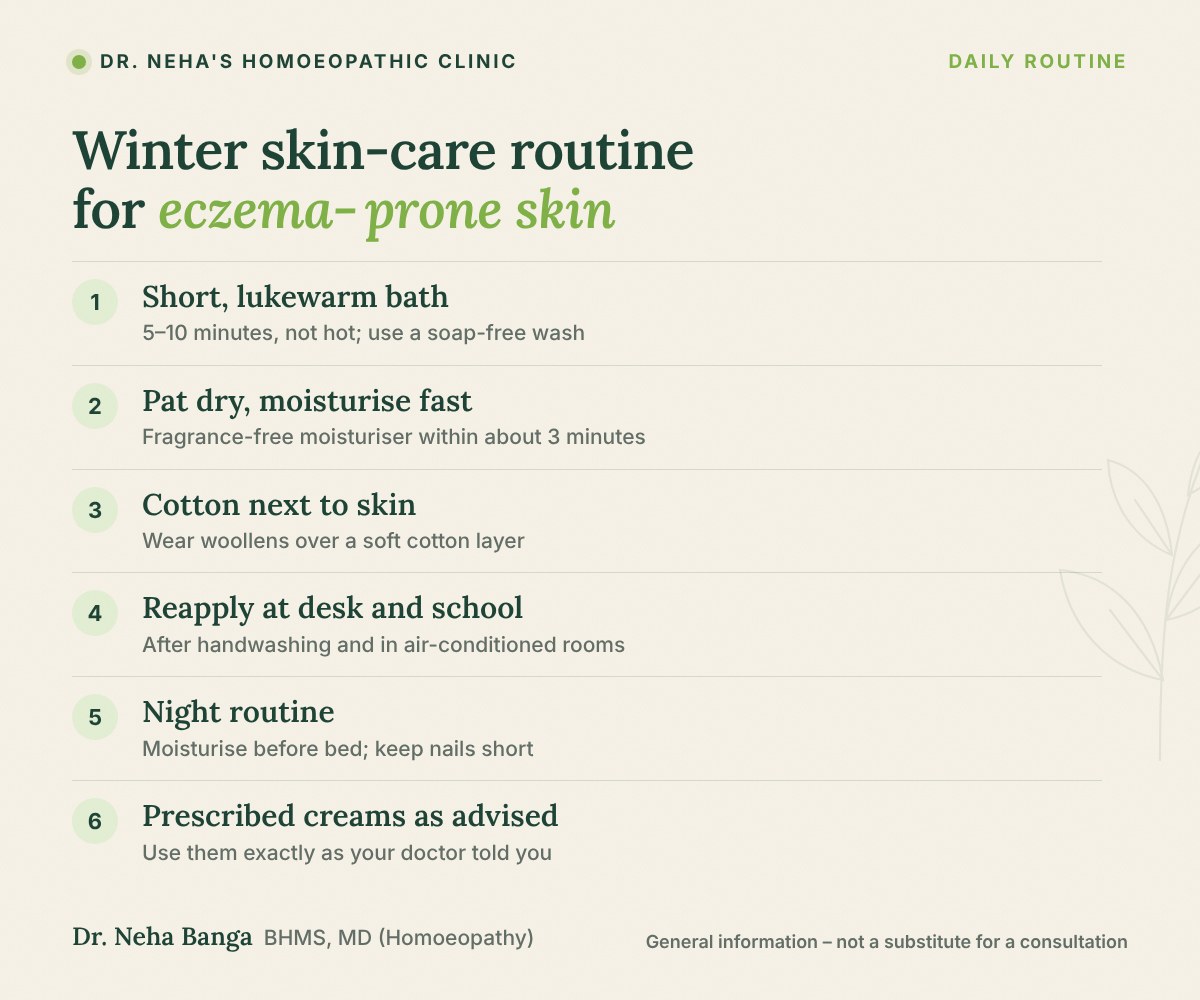
Use this as a general guide. Your dermatologist or paediatrician may give you a routine tailored to your skin – follow theirs first.
| When | What to do | Why it helps |
|---|---|---|
| Morning | Apply a thick, fragrance-free moisturiser to dry areas before dressing | Protects skin before dust, wind and AC |
| Bath time | Keep it short (5–10 minutes) and lukewarm, not hot. Use a soap-free wash or the soap substitute your doctor advised | Hot water and harsh soap strip the skin’s oils |
| Right after the bath | Pat dry gently with a soft towel – don’t rub. Apply moisturiser within about 3 minutes, while the skin is still slightly damp | Seals water into the skin |
| At work or school | Reapply moisturiser after washing hands and during long hours in AC rooms. Keep a small tube in your bag or on your desk | Daytime dryness builds up quickly |
| Clothing | Wear soft cotton next to the skin, with woollens over it. Wash clothes with a mild detergent and rinse well | Wool and detergent residue are common triggers |
| Night | Moisturise again before bed. Keep nails short; cotton gloves can help young children who scratch in their sleep | Most scratching happens during sleep |
| Prescribed creams | Use them exactly as your doctor advised – the right amount, on the right areas, for as long as told | Flare-ups need the treatment your doctor planned |
At home, wipe surfaces with a damp cloth rather than sweeping dust into the air.
How can you help a child with winter eczema?
Eczema in children is common, and winter mornings before school can be hard. Some simple steps help:
- Moisturise before the school uniform goes on, especially under woollen sweaters.
- Put a cotton vest or T-shirt under school woollens.
- Pack a small tube of moisturiser in the school bag, and ask the teacher if your child can use it after washing hands.
- Choose lukewarm baths, even when your child asks for hot water.
- Keep your paediatrician involved, and follow their advice on creams and any allergy tests.
Babies and toddlers need extra care. If an infant’s eczema is spreading, not settling, or making your baby very unsettled, see your paediatrician soon.
What about adults working long hours in AC offices?
Many IT professionals in Gachibowli and the Financial District spend nine or ten hours in air-conditioned offices. Hands take the worst of it – frequent washing and alcohol hand rubs dry them out. Keep a fragrance-free moisturiser at your desk and use it after every wash. Sip water through the day. Notice whether stress, late nights or deadlines line up with your flare-ups; many people find they do, and that is useful to share with your doctor.
When to see a doctor urgently
Get medical help the same day – do not wait for a routine appointment – if you or your child have:
- painful, clustered blisters or punched-out sores on eczema skin, often with fever or being unwell – this can be eczema herpeticum, a serious infection that needs same-day care
- signs of infection: oozing, yellow crusting, pus, skin that is hot and swollen, or a fever
- a rash that is spreading quickly
- eczema in a young baby that is widespread or getting worse
- eczema on or around the eyes with eye pain, redness or blurred vision
- itching so bad that sleep is badly affected night after night
For difficulty breathing, swelling of the face or lips, or someone who is very unwell, go to the nearest emergency department or call 108.
How can a homoeopathic consultation fit into eczema care?
We start with a detailed, individual history: when the eczema began, which areas it affects, what makes it better or worse, seasonal patterns, family history of eczema, allergies or asthma, sleep, stress, diet and daily routine. We also ask about every cream and medicine you use. From that, we agree a plan and a follow-up schedule, in clinic in Nallagandla or by online video consultation.
If needed, we also plan alongside treatment depending on the case and patient history – including the care your dermatologist or paediatrician has prescribed. Steroid creams, moisturisers and other treatments from your dermatologist are an important part of eczema care for many people. Please don’t stop any prescribed cream or medicine without talking to your doctor. Outcomes vary from person to person, and we will be honest with you at every review. If we think you need a dermatologist, tests or urgent care, we will tell you.
You can read more on our skin concerns page, learn how homoeopathy works alongside other medicines, or book a consultation.
Frequently asked questions
Is eczema contagious?
No. You cannot catch eczema from someone else. However, eczema skin that becomes infected needs medical attention, so watch for oozing, crusting or blisters.
Can children have homoeopathy for skin concerns alongside the paediatrician’s care?
Yes, depending on the case and history. Keep your paediatrician informed, continue every cream and medicine they prescribe, and bring a full list to each consultation.
How long does it take to see a change?
There is no fixed timeline. Eczema naturally comes and goes, and progress is reviewed over several visits. Our article on how long homoeopathy takes to work explains what affects this.
Should I change my diet if I have eczema?
Some young children with eczema also have food allergies, but please don’t cut out milk, eggs, wheat or other foods without medical advice – it can affect growth and nutrition. If you suspect a food trigger, discuss it with your paediatrician or doctor first.
Sources
- NHS – Atopic eczema: https://www.nhs.uk/conditions/atopic-eczema/
- National Institute of Arthritis and Musculoskeletal and Skin Diseases (NIH) – Atopic dermatitis: https://www.niams.nih.gov/health-topics/atopic-dermatitis
- American Academy of Dermatology – Eczema resource centre: https://www.aad.org/public/diseases/eczema
This article is for general information and is not a substitute for a consultation. Dr. Neha’s Homoeopathic Clinic, Doctor’s Colony, Gulmohar Park Colony, Nallagandla, Hyderabad 500019 · +91 75063 79868.